Whalenomics
Cloud economics across public cloud, on-prem and hybrid — one ledger.
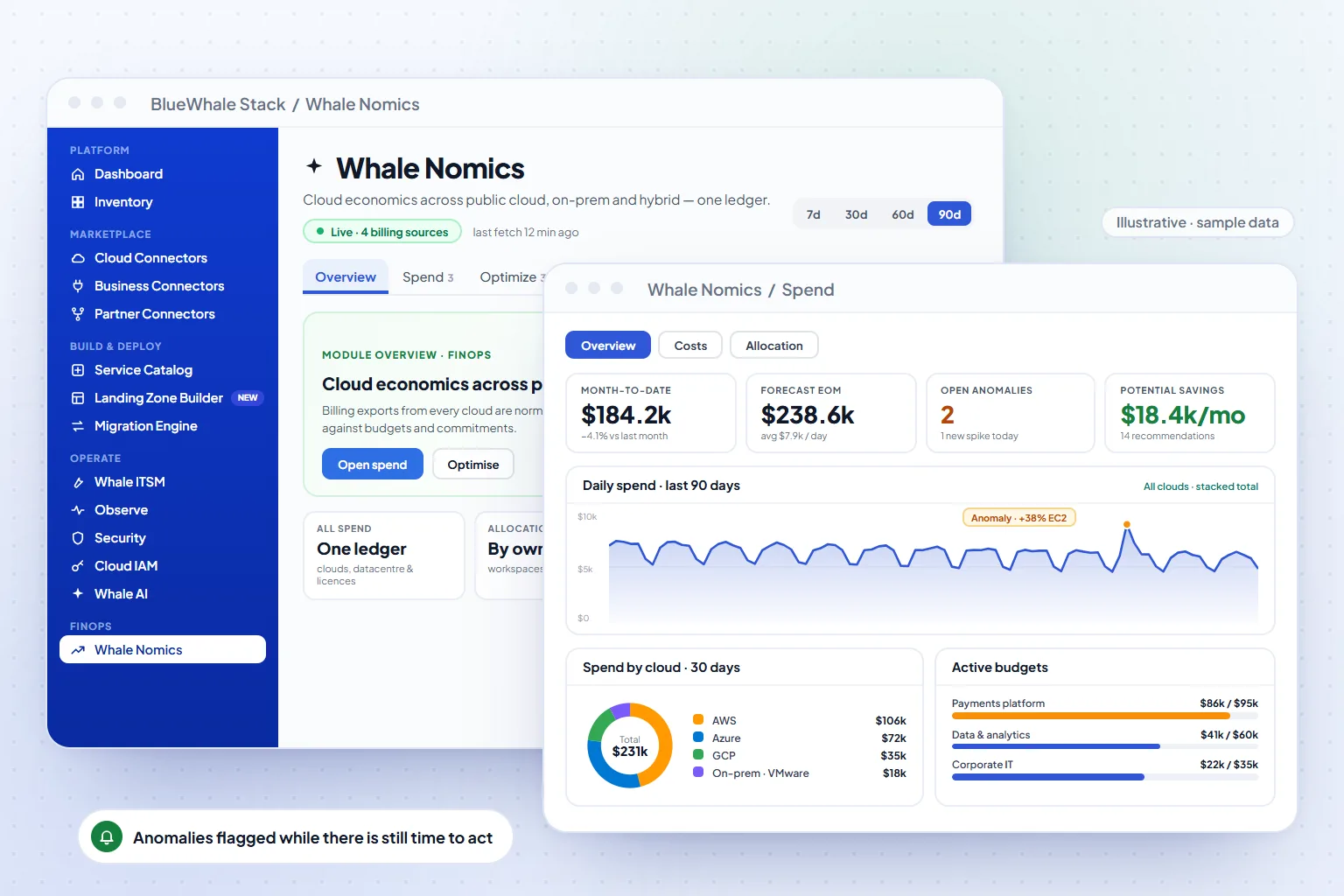
Whalenomics is the FinOps family: budgets, forecasts, chargeback and continuous optimisation, with spend decomposed to workload, department or tenant. Today the Whale AI FinOps use cases — cost narratives, anomaly explanations, rightsizing and commitment advice — run on live billing data from AWS, Azure and GCP; the full Whalenomics backend for budgets and chargeback is in progress.
- 0
- Whale AI FinOps use cases live today
- AWS · Azure · GCP
- Pricing maps and billing ingestion
- Per tenant
- Chargeback and metering model (in progress)
Capabilities
What Whalenomics does
Cost visibility with ownership
Billing records are joined to the inventory, so every dollar resolves to a workload, an owner and a tag — the basis for showback and chargeback.
Anomalies and explanations
Whale AI flags unusual spend and explains it in plain language against the inventory: what changed, where, and who owns it.
Rightsizing and commitments
Idle and oversized resources, storage tiers and commitment coverage are surfaced with the saving and the action — from the inventory, not a separate tool.
Budgets, forecasts, chargeback
Budgets per unit with forecasts and alerts, and chargeback into your ERP or an operator's BSS — the Whalenomics backend currently in progress.
How it works
3 steps, from first connection to steady state
Ingest and join
Billing exports from each cloud are normalised and joined to inventory and tags.
Explain
Whale AI answers 'why did this rise' with the resources behind the number.
Decide and allocate
Rightsize, commit, and allocate cost to the unit that owns it; budgets and forecasts follow.
Where it fits
One module of one platform
Shared platform
Capabilities
- One ledger — cloud bills plus datacentre and licence costs, normalised
- Allocated by owner through workspaces and tags
- Spend · Optimise · Govern · ESG — savings, guardrails and carbon
- Anomalies flagged before month-end, while there is time to act
Included in
Industries that rely on it
Questions
Questions teams ask before turning it on
Scope, permissions and maturity — answered the way we answer them in an evaluation.
01What is live today and what is in progress?
Live: cost visibility joined to inventory, anomaly detection and explanations, rightsizing and commitment advice — the twelve Whale AI FinOps use cases. In progress: the full Whalenomics backend for budgets, forecasts and chargeback feeds.
02Which clouds are covered?
Billing ingestion and pricing maps for AWS, Azure and GCP today; the other connected clouds contribute inventory and will follow for billing.
03Can chargeback feed our ERP or BSS?
That is the design goal of the Whalenomics backend: per-unit and per-tenant allocation exported to ERP, and for operators into their BSS through Tenancy & Monetization.
See it on your data
Whalenomics, on your own estate — in one working session.
Bring one cloud account or one on-prem site. We connect it read-only during the call, walk the module on your real resources, and leave you with the export.