Unified Cloud Inventory
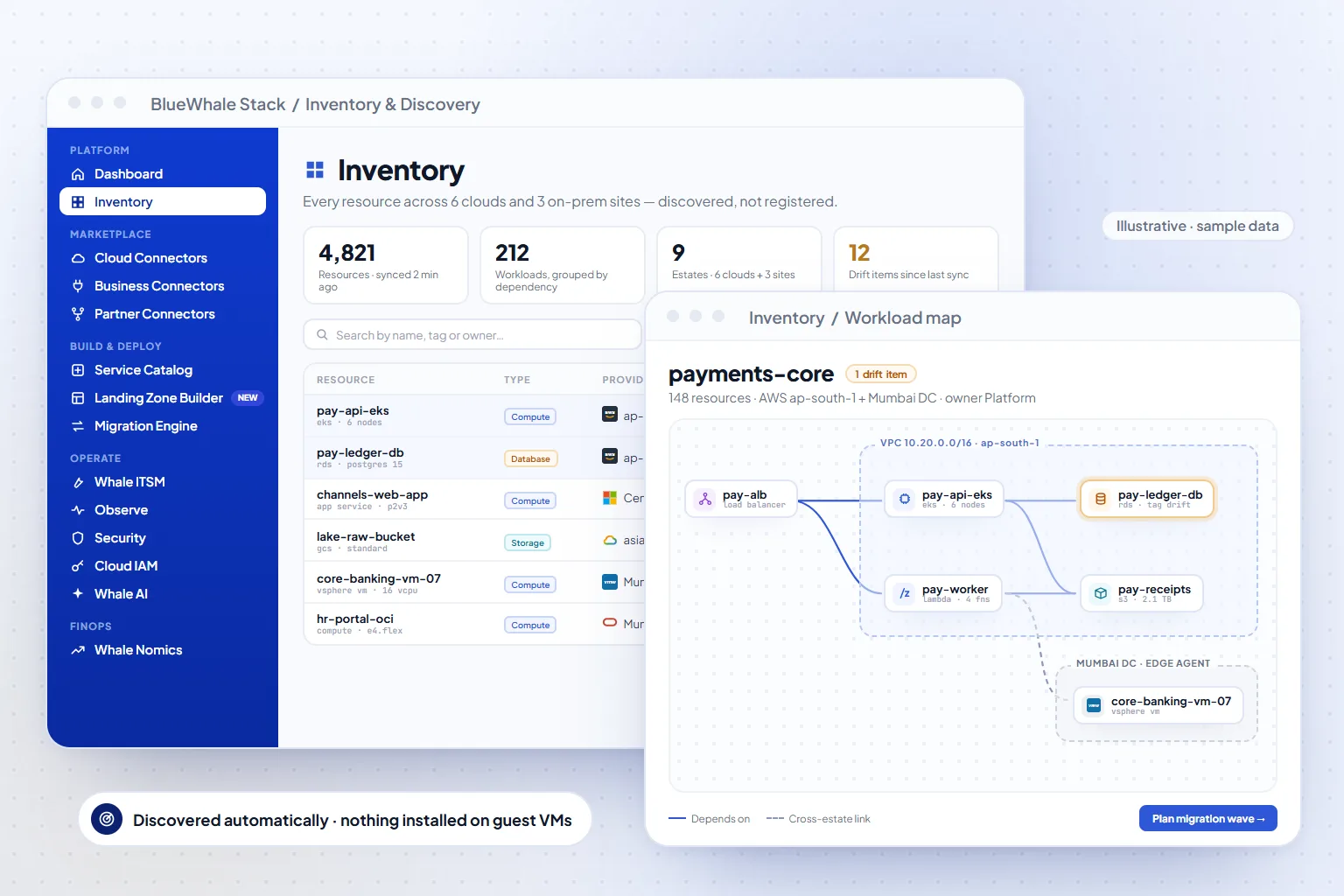
One live inventory of every resource across six public clouds plus on-prem and hybrid — grouped by workload, with lifecycle actions and exportable reports.

- < 15 min
- From connecting a cloud account to its first full inventory
- 6 + on-prem
- Public clouds by API, private platforms by Edge Agent
- 15 min
- Default re-discovery interval, with change events where the provider offers them
The challenge
Teams run AWS, Azure, GCP, Oracle and on-prem in separate consoles, so nobody has a single, current map of what the organisation is actually running.
- 01
Six consoles and a spreadsheet — the CMDB is out of date the day it is exported.
- 02
Ownership is unknown for a large share of resources, so idle spend and orphaned access persist.
- 03
Every audit, migration and cost exercise starts by rebuilding the same inventory by hand.
How it works
The data path, end to end
- Step 1:
Connect six public clouds with read-only credentials, and on-prem sites via the Edge Agent over outbound-only HTTPS.
- Step 2:
Every resource is discovered, normalised to one schema and grouped by workload.
- Step 3:
Teams search, filter and act on resources from the control plane; every action lands in the audit log.
- Step 4:
Reports export to PDF, Excel or CSV; the API feeds your CMDB or GRC tool.
- Step 5:
The same inventory feeds provisioning, observability, migration and governance.

Who it's for
CIOs, Heads of Infrastructure, and cloud platform teams who need one map of the estate.
Recommended editions
Related solutions
Questions
Questions teams ask in the evaluation
Scope, permissions, integrations and what is live today.
01What permissions does discovery need?
Read-only: an IAM role with a read policy on AWS, the Reader role on Azure subscriptions, the Viewer role on GCP projects, and equivalent read keys on Oracle, Alibaba and Huawei. Write actions are granted separately, per policy.
02How is on-prem discovered?
One Edge Agent per site talks to the hypervisor APIs — vCenter, Hyper-V, Prism, OpenShift — and reports over outbound HTTPS. Nothing is installed on guest VMs and no inbound firewall rule is needed.
03Can it replace our CMDB?
It can be the source for it. Configuration items and relationships come from live discovery, and the REST API or CSV export feeds ServiceNow or whichever CMDB you keep as the system of record.
Next step
Unified Cloud Inventory, on your own estate.
Bring one cloud account or one on-prem site. We connect it read-only during the session, walk this workflow on your real resources, and leave you with the export.